In this blog learn the conditionals, learn to also make sentences and how to solve them in just 3 hours
https://www.youtube.com/watch?v=S4dlClQdCi8
Try it...
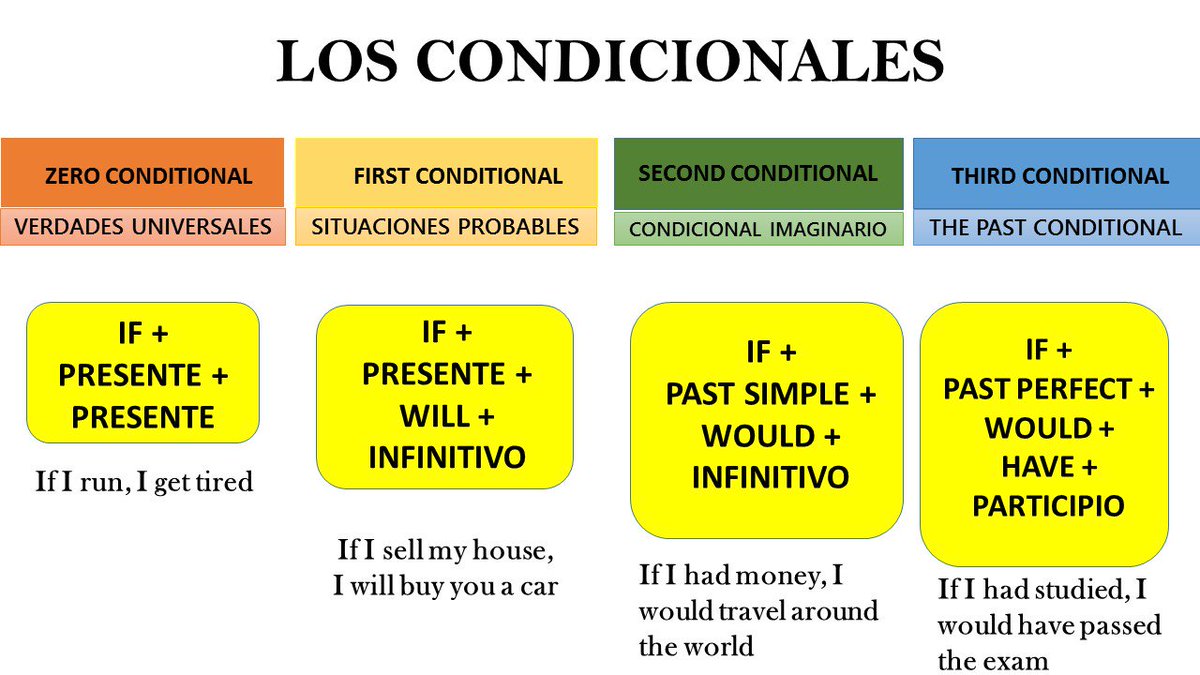
THE CONDITIONALS Conditional tenses are used to speculate about what could happen, what might have happened, and what we wish would happen. In English, most sentences using the conditional contain the word if. Many conditional forms in English are used in sentences that include verbs in one of the past tenses. This usage is referred to as "the unreal past" because we use a past tense but we are not actually referring to something that happened in the past. There are five main ways of constructing conditional sentences in English. In all cases, these sentences are made up of an if clause and a main clause. In many negative conditional sentences, there is an equivalent sentence construction using "unless" instead of "if".
We can make
a zero conditional sentence with two present simple verbs (one in the 'if
clause' and one in the 'main clause'
If +
present simple, .... present simple.
This
conditional is used when the result will always happen. So, if water reaches
100 degrees, it always boils. It's a fact. I'm talking in general, not about
one particular situation. The result of the 'if clause' is always the main
clause.
The 'if' in
this conditional can usually be replaced by 'when' without changing the
meaning.
For
example: If water reaches 100 degrees, it boils. (It is always true, there
can't be a different result sometimes). If I eat peanuts, I am sick. (This is
true only for me, maybe, not for everyone, but it's still true that I'm sick
every time I eat peanuts) Speaking of clauses
The conditional zero formulation in English involves two clauses. The first clause, known as the si
clause
(the clause that starts with if) or the conditional
clause
(the conditional clause), introduces a condition. The second clause, known as the main one
clause
(the main clause), introduces a possible result of the conditional clause.
A clause is defined as a set of words that form a complete sense.
A simple sentence like I am a student (I am a student.) It has a clause.A complex sentence like I am a student, but she is a teacher (i am a student,but she is a teacher)It has two clauses.
https://www.youtube.com/watch?v=PDtUTAwMGDQ
sábado, 13 de octubre de 2018
The first conditional
it is used to refer to the present or future when the situation is real. Conditional type 1 refers to a possible condition and its probable outcome. In these sentences, the "if" clause adopts the "simple present" and the main proposition the "simple future".
The Second Conditional is used to express hypogenetic conditions referred to the present, something that is unlikely to occur. An example in Spanish would be "If I had a car, I would go to the beach".
The structure of the second conditional is that of if + simple past + simple conditional (or the modal verbs could and might).
An example: If I had a car, I would go to the beach (If I had a car, I would go to the beach).
As you see if we want to replace the conditional with a modal verb (in this case could or might) we would not have any problem, it would only change in the fact that the probability would be even lower. The sentence would be as follows:
https://www.youtube.com/watch?v=TWBu4iqojl4
jueves, 11 de octubre de 2018
The third conditional
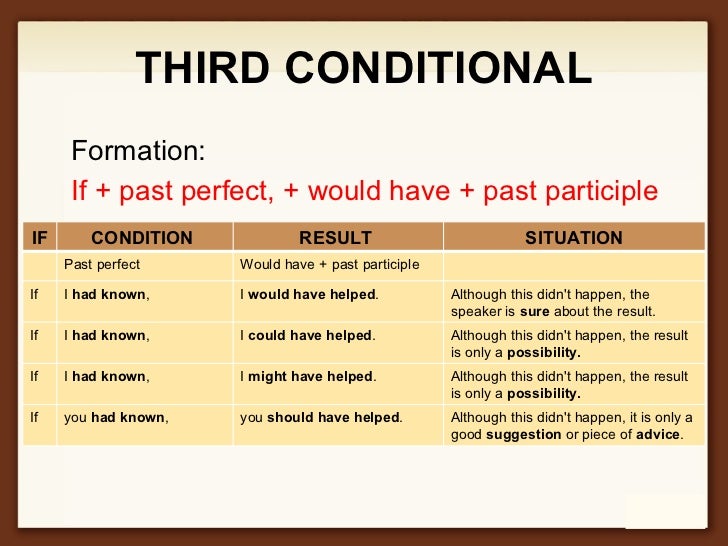
The third conditional in English is used to talk about situations that have not really taken place, these are hypotheses. Very often they are used to talk about something that we regret, but also to reproach something or simply to imagine a situation that could have developed in a different way.