lunes, 15 de octubre de 2018

WELCOME


Resultado de imagen para ayudas en el ingles


In this blog learn the conditionals, learn to also make sentences and how to solve them in just 3 hours


https://www.youtube.com/watch?v=S4dlClQdCi8


Try it...
                                    THE CONDITIONALS

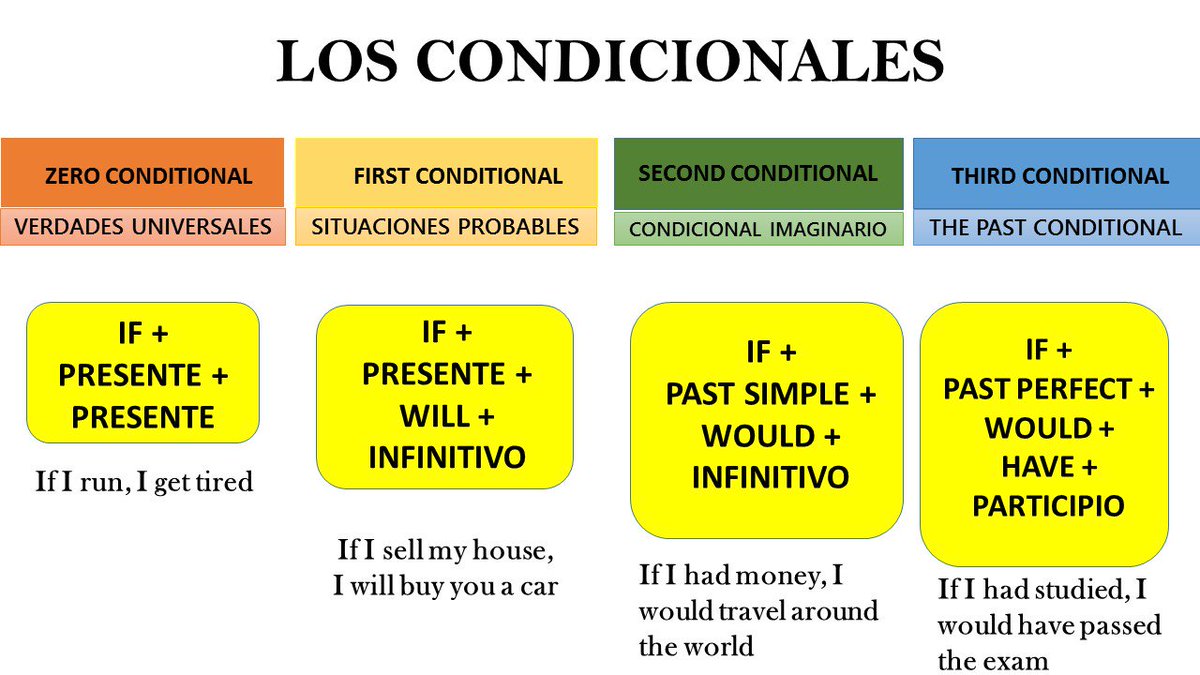
Conditional tenses are used to speculate about what could happen, what might have happened, and what we wish would happen. In English, most sentences using the conditional contain the word if. Many conditional forms in English are used in sentences that include verbs in one of the past tenses. This usage is referred to as "the unreal past" because we use a past tense but we are not actually referring to something that happened in the past. There are five main ways of constructing conditional sentences in English. In all cases, these sentences are made up of an if clause and a main clause. In many negative conditional sentences, there is an equivalent sentence construction using "unless" instead of "if".


Resultado de imagen para los condicionales
https://www.google.com.co/search?q=los+condicionales&source=lnms&tbm=isch&sa=X&ved=0ahUKEwiJzYOnv5LdAhXRuVkKHX8oB2kQ_AUICigB&biw=1366&bih=662#imgrc=8-dnk_83ORdTVM:


https://www.youtube.com/watch?v=OyxF4grou0Y


domingo, 14 de octubre de 2018


THE ZERO CONDITIONAL

We can make a zero conditional sentence with two present simple verbs (one in the 'if clause' and one in the 'main clause'

If + present simple, .... present simple.

This conditional is used when the result will always happen. So, if water reaches 100 degrees, it always boils. It's a fact. I'm talking in general, not about one particular situation. The result of the 'if clause' is always the main clause.
The 'if' in this conditional can usually be replaced by 'when' without changing the meaning.

For example: If water reaches 100 degrees, it boils. (It is always true, there can't be a different result sometimes). If I eat peanuts, I am sick. (This is true only for me, maybe, not for everyone, but it's still true that I'm sick every time I eat peanuts)

Speaking of clauses

The conditional zero formulation in English involves two clauses. The first clause, known as the si
clause

(the clause that starts with if) or the conditional
clause

(the conditional clause), introduces a condition. The second clause, known as the main one
clause


(the main clause), introduces a possible result of the conditional clause.

Here are some more examples:


Resultado de imagen para zero conditional
https:///search?biw=1366&bih=662&tbm=isch&sa=1&ei=5rGGW922KseK5wL-6bKoBg&q=zero+conditional+&oq=zero+conditional+&gs_l=img.3..0l10.17460.17460.0.18644.1.1.0.0.0.0.276.276.2-1.1.0....0...1c.1.64.img..0.1.274....0._c6Q29aDKBE#imgrc=vS8NXj2YiZgFcM:

To refresh the memory
A clause  is defined as a set of words that form a complete sense.

A simple sentence like I am a student  (I am a student.) It has a clause.A complex sentence like I am a student, but she is a teacher (i am a student,but she is a teacher)It has two clauses.


https://www.youtube.com/watch?v=PDtUTAwMGDQ


sábado, 13 de octubre de 2018

The first conditional


it is used to refer to the present or future when the situation is real. Conditional type 1 refers to a possible condition and its probable outcome. In these sentences, the "if" clause adopts the "simple present" and the main proposition the "simple future".


Resultado de imagen para 1 conditional

https://www.google.com.co/searchq=1+conditional&source=lnms&tbm=isch&sa=X&ved=0ahUKEwjuwtDfo8fdAhXIuVMKHfH2AEYQ_AUICigB&biw=1366&bih=662#imgrc=dSdb88ihnGd7EM:


https://www.youtube.com/watch?v=hT5PWuuxaKM

viernes, 12 de octubre de 2018

The second conditional


The Second Conditional is used to express hypogenetic conditions referred to the present, something that is unlikely to occur. An example in Spanish would be "If I had a car, I would go to the beach".

Resultado de imagen para que es el second conditional

https://www.google.com.co/search?q=que+es+el+second+conditional&source=lnms&tbm=isch&sa=X&ved=0ahUKEwj64_e5psfdAhUFzlMKHcKqCWcQ_AUICigB&biw=1366&bih=662#imgrc=BWuBWZt4qu60pM:

The structure of the second conditional is that of if + simple past + simple conditional (or the modal verbs could and might).

An example: If I had a car, I would go to the beach (If I had a car, I would go to the beach).

As you see if we want to replace the conditional with a modal verb (in this case could or might) we would not have any problem, it would only change in the fact that the probability would be even lower. The sentence would be as follows:

https://www.youtube.com/watch?v=TWBu4iqojl4

jueves, 11 de octubre de 2018


The third conditional


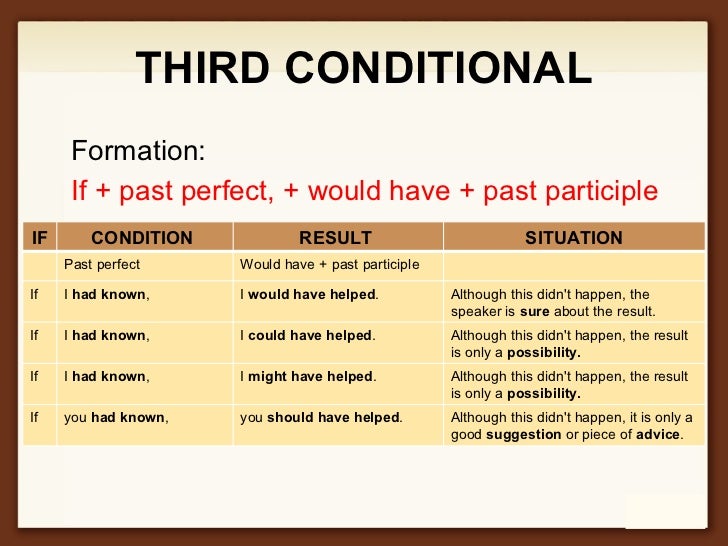
The third conditional in English is used to talk about situations that have not really taken place, these are hypotheses. Very often they are used to talk about something that we regret, but also to reproach something or simply to imagine a situation that could have developed in a different way.


Resultado de imagen para third conditional

https://www.google.com.co/search?q=third+conditional&rlz=1C1AVNG_enCO650CO650&source=lnms&tbm=isch&sa=X&ved=0ahUKEwiFjtPnyKneAhXpx1kKHeqLCbMQ_AUIDygC&biw=1366&bih=657#imgrc=wcYPhrsehcDxnM:


https://www.youtube.com/watch?v=TcrN0N8o494&t=26s


viernes, 5 de octubre de 2018

Conditionals exercises 


Complete the sentences with the correct form of the verb found in parentheses.


Sample
If I win the lottery, I ____ (buy) a new car. 
Q1 of 8
If we spoke better English, we ____ (move) to the United States. 
Q2 of 8
If it ____ (rain), we should go to the movies. 
Q3 of 8
They ____ (wait, not) in the rain, had you called them to tell them you were going to be late. 
Q4 of 8
If Peter ____ (work) less, he would have more time to study. 
Q5 of 8
It would have been a nice holiday, if I ____ (break, not) my leg. 
Q6 of 8
_____ you _____ (go) to a different show if you can't get tickets to "Les Miserables"? 
Q7 of 8
If she were shorter, she ____ (wear) high heels more often. 
Q8 of 8
_____ you _____ (be) angry if I hadn't called to tell you I would be late? 

jueves, 4 de octubre de 2018


conditional exercises answers

Q1 of 8
If we spoke better English, we ____ (move) to the United States.
Respuesta incorrecta: La respuesta correcta es:
If we spoke better English, we would move to the United States.
Se utiliza el tipo 2 para expresar una posibilidad irreal en el presente, como un deseo o un sueño, o para una acción en el futuro no muy probable. En este tipo de condicional, se utiliza el pasado simple y el auxiliar "would" + infinitivo.

Q2 of 8
If it ____ (rain), we should go to the movies.
Respuesta incorrecta: La respuesta correcta es:
If it rains , we should go to the movies.
Se utiliza el tipo 1 del condicional para el futuro. Podemos usar algunos verbos modales (como "should" o "could) en vez de "will" para cambiar la probabilidad o expresar una opinión.

Q3 of 8
They ____ (wait, not) in the rain, had you called them to tell them you were going to be late.
Respuesta incorrecta: La respuesta correcta es:
They would not have waited / wouldn't have waited in the rain, had you called them to tell them you were going to be late.
A diferencia de los tipos 1 y 2, se utiliza el tercer tipo del condicional cuando hablamos de una condición en el pasado que no ha sucedido. En el tipo 3, se utiliza el pasado perfecto y "would have" + el participio pasado.

Q4 of 8
If Peter ____ (work) less, he would have more time to study.
Respuesta incorrecta: La respuesta correcta es:
If Peter worked less, he would have more time to study.
Se utiliza el tipo 2 para expresar una posibilidad irreal en el presente, como puede ser un deseo o un sueño, o para una acción en el futuro no muy probable. En este tipo de condicional, se utiliza el pasado simple y el auxiliar "would" + infinitivo.

Q5 of 8
It would have been a nice holiday, if I ____ (break, not) my leg.
Respuesta incorrecta: La respuesta correcta es:
It would have been a nice holiday, if I had not broken /hadn't broken my leg.
A diferencia de los tipos 1 y 2, se utiliza el tercer tipo del condicional cuando hablamos de una condición en el pasado que no ha sucedido. En el tipo 3, se utiliza el pasado perfecto y "would have" + el participio pasado.

Q6 of 8
you to a different show if you can't get tickets to "Les Miserables"?
Respuesta incorrecta: La respuesta correcta es:
Will you go to a different show if you can't get tickets to "Les Miserables"?
Se utiliza el tipo 1 del condicional para el futuro. Cuando la condición se da en el presente simple, se usa "will" con el otro verbo.

Q7 of 8
If she were shorter, she ____ (wear) high heels more often.
Respuesta incorrecta: La respuesta correcta es:
If she were shorter, she would wear high heels more often.
Se utiliza el tipo 2 para expresar una posibilidad irreal en el presente, como puede ser un deseo o un sueño, o para una acción en el futuro no muy probable. En este tipo de condicional, se utiliza el pasado simple y el auxiliar "would" + infinitivo.

Q8 of 8
you angry if I hadn't called to tell you I would be late?
Respuesta incorrecta: La respuesta correcta es:
Would you have been angry if I hadn't called to tell you I would be late?
A diferencia de los tipos 1 y 2, se utiliza el tercer tipo del condicional cuando hablamos de una condición en el pasado que no ha sucedido. En el tipo 3, se utiliza el pasado perfecto y "would have" + el participio pasado.

martes, 2 de octubre de 2018


 Exercise: first conditional vs. second conditional 

Exercise instructions

Decide whether the following sentences should be in the first or second conditional and put the verb in brackets into the appropriate form:

1He's coming to our offices tomorrow. If I (see)  him, I'll give him the message. 
2We (move)  if we had the money. Unfortunately new houses are very expensive in this area. 
3If I (be)  a millionaire, I'd still work so that I didn't get bored. 
4If I (tell)  you a secret, will you promise not to tell anyone? 
5Do you think it would be better if I (wait)  another week, or shall I sell my shares in the company now? 
6If he causes any more problems, I (fire)  him. 
7Would you mind if I (open)  the window? It's really hot in here. 
8If I (lose)  my job, I'd apply to join the police. 
9Where would you go if you (can)  go anywhere in the world? 
10If you (see)  her, say hello. 


lunes, 1 de octubre de 2018

Answers from first conditional vs second conditional
1He's coming to our offices tomorrow. If I (see)  him, I'll give him the message. 
Correct answer: see
2We (move)  if we had the money. Unfortunately new houses are very expensive in this area. 
Correct answer: would move
3If I (be)  a millionaire, I'd still work so that I didn't get bored. 
Correct answer: were / was
4If I (tell)  you a secret, will you promise not to tell anyone? 
Correct answer: tell
5Do you think it would be better if I (wait)  another week, or shall I sell my shares in the company now? 
Correct answer: waited
6If he causes any more problems, I (fire)  him. 
Correct answer: will fire
7Would you mind if I (open)  the window? It's really hot in here. 
Correct answer: opened
8If I (lose)  my job, I'd apply to join the police. 
Correct answer: lost
9Where would you go if you (can)  go anywhere in the world? 
Correct answer: could
10If you (see)  her, say hello. 
Correct answer: see